
+86 13923163484
info@fufujing.com

Concrete is standardly recognized as the primary building material for heavy civil engineering, industrial installations, and infrastructure projects worldwide. Engineered to bear substantial structural loads, withstand continuous hydrostatic water pressure, and resist harsh environmental exposure, concrete provides the foundational integrity required for critical structures. However, even the most rigorously designed concrete pours contain inherent vulnerabilities—most notably at the joint interfaces where adjacent concrete placements meet.
Concrete joints are unavoidable structural features. Whether created intentionally to allow for thermal expansion and concrete curing shrinkage, or necessitated by daily construction pour limits, these seams represent continuous discontinuities through the concrete mass. Without a robust, permanently resilient internal sealing solution, water under pressure easily migrates through micro-fissures, cold joints, and joint gaps. Left unsealed, water ingress rapidly degrades reinforcing steel through corrosion, accelerates freeze-thaw spalling, and leads to eventual structural deterioration.
A PVC Centre Bulb Waterstop represents one of the most effective and time-tested solutions for high-performance dynamic joint waterproofing. Engineered specifically to be embedded directly into the concrete matrix across joint lines, this specialized thermoplastic profile provides a permanent barrier against fluid passage while actively accommodating multi-axial movement between concrete sections. The defining feature—a hollow, flexible center bulb—serves as an internal expansion chamber that stretches, compresses, and shear-deforms as concrete slabs or walls shift over time.
For high-consequence infrastructure such as underground rail networks, deep foundations, dam spillways, water treatment reservoirs, and sub-grade containment facilities, specifying the correct waterstop profile alongside its corresponding field installation equipment is fundamental to preserving long-term structural durability and watertight integrity.
| Table of Contents | |
|---|---|
| 1 | |
| 2 | |
| 3 | |
| 4 | |
| 5 | |
| 6 | |
| 7 | |
| 8 | |
| 9 | |
| 10 | |
| 11 | |
A PVC centre bulb waterstop is a high-grade elastomeric plastic seal designed specifically for internal installation within concrete expansion and movement joints. Unlike external sealants or membrane flashings applied exclusively to concrete surfaces after curing, an internal waterstop is positioned prior to pouring and becomes an integral, permanently encapsulated element of the structural joint.
The defining characteristic of a centre bulb waterstop is its unique cross-sectional geometry. Located in the direct midpoint of the web is a hollow, flexible tubular section—the bulb—flanked by flat flexible wings equipped with raised longitudinal ribs or anchors. The central bulb acts as an isolated deformation cell positioned squarely across the joint gap, remaining free from concrete bonding so it can flex independently as joint dimensions expand, contract, or shear.
| Component | Key Function |
|---|---|
| Centre bulb section | Flexes to absorb multi-directional joint displacement without stressing adjacent concrete |
| PVC body | Delivers elastic memory, high tensile strength, and long-term fluid barrier performance |
| Ribbed edges | Interlocks mechanically with surrounded concrete matrix to eliminate lateral water tracking |
During construction, the profile is secured along the centerline of the joint prior to the initial concrete pour, placing one ribbed side into the first concrete section while leaving the opposite side exposed for the second pour. Once both placements solidify, the outer flanges become mechanically anchored into the surrounding concrete matrix.
Compared to surface-applied sealants, which rely on adhesive bonds susceptible to peel failure, UV degradation, and hydrostatic blowout, an internal PVC centre bulb waterstop relies on mechanical anchorage and continuous elastomeric barrier properties. This makes it infinitely superior for retaining liquid pressure under high water heads in subterranean and aquatic structures.
FuFuJing produces a versatile lineup of PVC waterstop profiles engineered using virgin polyvinyl chloride resins, offering tailored choices in web width, bulb diameter, and flange thickness to meet precise structural engineering specifications.
Understanding the mechanical and hydraulic behavior of a PVC centre bulb waterstop is essential for structural engineers and waterproofing contractors when specifying joint protection. The component performs two synchronized functions: absorbing joint displacement and establishing an impassable physical barrier against liquid transmission.
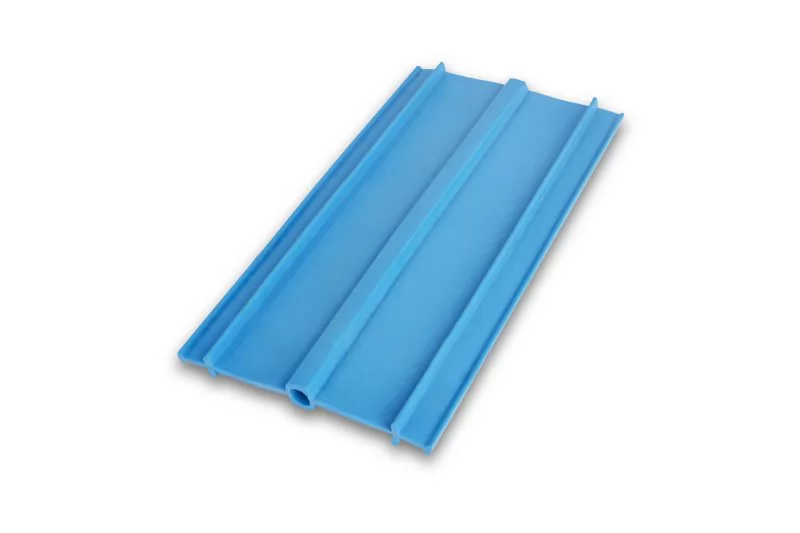
Concrete masses undergo continuous dimension changes throughout their entire design life. These volumetric fluctuations stem from several environmental and mechanical drivers:
When movement occurs at a concrete joint, rigid materials or flat waterstops without a center bulb experience high internal stresses that often cause tears, adhesive debonding, or cracking along the concrete interface. The central hollow bulb of a centre bulb waterstop overcomes this by acting as an internal stress-relief hinge. As adjacent concrete slabs move apart, the bulb elongates; as they move closer, the bulb compresses; when differential movement occurs, the bulb deforms in shear. This flexibility allows the joint to flex freely without compromising the waterproof barrier or placing excessive stress on the anchored flanges.
The hydraulic sealing mechanism of a centre bulb waterstop relies on the "tortuous path principle." Water under pressure attempts to pass through any structural gap along the path of least resistance. By embedding a continuous, wide PVC barrier across the joint interface, water is forced to travel around the entire width of the profile, navigating multiple outer ribs, anchoring keyways, and web surfaces to breach the seal.
The high-contact pressure between the concrete and the elastomeric PVC ribs forms an impenetrable mechanical seal. The effectiveness of this system depends directly on four critical installation factors:
Working alongside an experienced manufacturer like FuFuJing guarantees access to technical documentation, proper material testing certification, and comprehensive on-site installation guidance for critical projects.
PVC centre bulb waterstops are deployed extensively across civil engineering, municipal infrastructure, and industrial construction projects where high groundwater pressure or liquid containment requires dependable dynamic joint sealing.
Hydroelectric dams, spillways, water storage reservoirs, and canals store immense volumes of liquid, creating constant, high-head hydrostatic pressure against concrete structures. Expansion joints in massive concrete pours must accommodate thermal expansion and structural flexing without letting water bypass the joint. Center bulb waterstops deliver the ultimate combination of high pressure resistance and dynamic elastic recovery required for continuous underwater operation over many decades.
Subterranean facilities operate below local water tables, facing relentless external groundwater pressure and complex soil stress distribution. Rail and highway tunnels, subway stations, utility vaults, and deep foundation basements rely heavily on internal PVC centre bulb waterstops across:
The flexible nature of the central bulb ensures that minor structural settling or ground movement does not breach the subterranean water envelope.
Wastewater treatment plants contain aggressive liquid chemical environments and organic waste matter. Concrete aeration basins, primary clarification tanks, sludge digesters, and secondary containment structures demand waterstops capable of resisting both dynamic movement and chemical attack. High-grade PVC profiles resist micro-organism growth, dilute acids, industrial effluents, and wastewater treatment chemicals while maintaining joint integrity.
Commercial high-rise basements, underground parking structures, commercial aquariums, and municipal swimming pools require reliable waterproofing protection from both internal liquid retention and external groundwater ingress. Deploying FuFuJing PVC centre bulb waterstops across all primary dynamic joints mitigates dampness, prevents structural corrosion, and lowers long-term building maintenance overheads.
Selecting the appropriate waterstop cross-section is a fundamental decision in concrete joint engineering. While all PVC waterstops share the primary objective of blocking water transmission, different profile geometries are tailored for specific mechanical joint behaviors and installation conditions.
| Waterstop Type | Typical Application | Movement Capacity |
|---|---|---|
| Centre Bulb Waterstop | Expansion joints, settlement joints, dynamic movement seams | High |
| Flat Ribbed Waterstop | Static construction joints, cold joints, pour breaks | Medium |
| Dumbbell Waterstop | Heavy-duty structural joints with high shear stress | Medium to High |
Specifically designed for active joints where structural movement—expansion, contraction, and lateral shear—is anticipated during the building's operational lifespan. The hollow central bulb acts as an expansion bellows, allowing significant multi-axis movement without over-stressing the embedded web flanges or damaging the concrete interface. This profile is essential for dams, tunnels, bridge abutments, and large foundation slabs with expansion joints.
Engineered primarily for static construction joints, cold joints, and daily pour breaks where negligible movement is expected once the concrete cures. The flat web design features multiple raised ribs on both sides to maximize surface contact length with the concrete matrix, forming an intricate mechanical path that blocks liquid migration. While highly economical for static cold joints, flat ribbed profiles lack a central expansion bulb and should not be specified for active expansion joints.
Features solid, thick rounded ends connected by a flat web, providing heavy-duty anchoring performance in thick concrete sections subjected to high hydrostatic heads. Often specified where shear movements dominate or where heavy reinforcement placement makes thin ribbed profiles prone to distortion.
Engineers select among these options by evaluating four core criteria: maximum expected joint movement, calculated hydrostatic pressure, minimum structural slab thickness, and physical access for reinforcement tying.
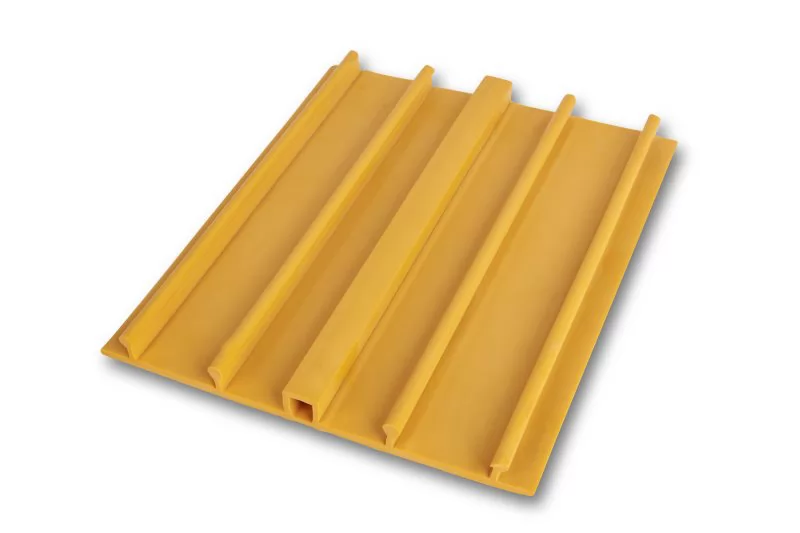
Selecting the correct PVC centre bulb waterstop requires matching the product's physical dimensions, material properties, and chemical profile to the exact mechanical and environmental demands of the project.
The first step is determining the specific movement characteristics of the concrete joint:
The operational longevity of a waterstop hinges on the quality of its PVC compound. High-grade waterstops must be extruded exclusively from virgin polyvinyl chloride resins combined with non-migrating plasticizers and stabilizers. Premium PVC waterstops exhibit key physical properties:
Inferior profiles manufactured using recycled scrap plastics degrade rapidly when exposed to concrete alkalis, becoming brittle and cracking within a few years of installation.
PVC centre bulb waterstops are available in standard widths ranging from 150mm (6 inches) up to 330mm (13 inches) with web thicknesses between 3mm and 10mm. Selecting the proper size involves three rules of thumb:
For engineering contractors and international material procurement managers, partner selection is as crucial as product selection. A professional PVC waterstop manufacturer should demonstrate certified quality management systems (ISO 9001), offer custom extrusion capabilities for non-standard project geometries, supply testing certificates for raw materials, and maintain reliable production output to hit construction timelines.
FuFuJing collaborates directly with client engineering teams to review structural drawings, recommend optimized specifications, and produce bespoke PVC profiles matched to exacting jobsite requirements.
Even the highest-grade PVC centre bulb waterstop will fail to deliver waterproofing performance if installed incorrectly. Flawless positioning, rigid anchoring, precise thermal splicing, and thorough concrete consolidation are vital to establishing an impenetrable joint seal.
Because waterstop rolls must be joined together on site to form continuous waterproofing loops, field splicing is required. PVC is a thermoplastic resin, meaning connections must be formed via full-penetration thermal heat welding—never with solvent cements, adhesive tapes, or mechanical lap seams.
To achieve continuous, full-strength splices, FuFuJing provides specialized installation tools:
The heat-welding process involves clamping profile ends into the jig, pressing them against the heated blade until a melt bead forms, removing the blade, and firmly pressing the molten ends together until fully cooled.
During concrete pouring and compaction, workers must take precautions to protect the waterstop assembly:
Joint leakage in concrete structures is rarely caused by manufacturing defects in the PVC resin itself; rather, it typically stems from field installation errors or improper profile specification:
Yes. Large civil engineering projects frequently encounter unique structural geometries, aggressive chemical exposures, or extreme hydrostatic pressures requiring custom waterstop solutions. Customization parameters commonly cover:
When formulated from high-purity virgin PVC resins and installed according to strict engineering standards, a PVC centre bulb waterstop remains functional for the full design life of the concrete structure—typically 50 to over 100 years. Because the embedded profile is shielded from direct solar UV radiation inside the concrete mass, it maintains elastic seal performance indefinitely.
FuFuJing is a dedicated manufacturer focusing exclusively on advanced concrete joint waterproofing systems. Rather than treating waterstops as a minor side-line product, FuFuJing concentrates its research, extrusion technology, and quality control on high-performance elastomeric profiles. The comprehensive product lineup features:
This allows clients to source both specialized waterproofing materials and their required site installation equipment from a single expert manufacturer.
Recognizing that civil engineering challenges vary across environments, FuFuJing provides tailored technical support for custom applications. Whether supplying high-head dam construction, subterranean rail networks, or chemical processing plants, FuFuJing customizes dimensions, profile shapes, and raw material properties to meet client specifications.
A high-performance waterstop system relies on execution quality in the field. By supplying high-purity PVC profiles alongside specialized field splicing equipment—including heater blades and alignment jigs—FuFuJing helps contractors execute clean, robust, and permanent thermal welds on site, ensuring complete waterproofing reliability from factory to finished structure.
PVC centre bulb waterstop is primarily used to seal active concrete expansion and movement joints. The central hollow bulb flexes to absorb expansion, contraction, and differential settlement without compromising the continuous waterproof barrier.
The main difference lies in movement capability. Centre bulb waterstops feature a hollow center section designed to flex under joint displacement, whereas flat ribbed waterstops lack a hollow bulb and are designed primarily for static construction cold joints with minimal movement.
It is installed in high-consequence concrete structures such as hydroelectric dams, water reservoirs, wastewater treatment plants, subway tunnels, underground parking basements, aqueducts, and deep foundation retaining walls.
They are joined by thermal heat welding. The profile ends are melted using a thermostatically controlled heating blade, then clamped together using jointing jigs until the molten PVC fuses into a single continuous piece.
Yes. Professional manufacturers like FuFuJing can custom-extrude profiles in non-standard widths, web thicknesses, bulb diameters, and chemical-resistant formulations to suit project specifications.
PVC centre bulb waterstops represent a vital line of defense for protecting critical concrete infrastructure against water ingress and structural deterioration. By combining dynamic multi-axis flexibility with a continuous embedded fluid barrier, the centre bulb profile successfully addresses the inherent challenge of sealing active expansion joints and movement joints exposed to high hydrostatic water pressure.
Achieving long-term waterproofing success requires a holistic approach: matching the profile size and material specs to site conditions, ensuring precise installation alignment, making clean heat welds, and consolidating concrete thoroughly around the profile.
As a specialized manufacturer of PVC Waterstops and site installation accessories, FuFuJing delivers precision-engineered profiles, custom manufacturing capability, and complete technical support to construction teams worldwide. Choosing high-grade materials and experienced manufacturing support is the most reliable path to achieving durable, watertight concrete structures that stand the test of time.


