

Are you specifying a waterproofing system for a concrete structure with expansion joints? Selecting the right expansion joint waterstop is essential when the joint must accommodate structural movement while preventing water from passing through the concrete assembly. Unlike static construction joints, expansion joints are designed to open, close, or shift over time, which places additional demands on the waterstop profile, material flexibility, and installation details.
If the answer is yes, then understanding how joint movement, water pressure, concrete geometry, and installation conditions affect waterstop performance can help you make a more reliable specification decision. This guide explains the key engineering factors to evaluate, compares internal and external configurations, and outlines the information that should be included in a project specification.
- Why Expansion Joints Need Specialized Waterstops
- How Joint Movement Affects Waterstop Performance
- Five Factors to Consider When Specifying an Expansion Joint Waterstop
- Internal vs. External Expansion Joint Waterstops
- How to Match Waterstop Profiles with Project Conditions
- Common Specification Mistakes That Can Lead to Leakage
- What to Include in an Expansion Joint Waterstop Specification
- Choosing a Waterstop Manufacturer for Custom Project Requirements
- Conclusion
1. Why Expansion Joints Need Specialized Waterstops
Concrete structures experience dimensional changes throughout their service life. Temperature fluctuations, drying shrinkage, creep, settlement, and applied structural loads can all cause adjacent concrete sections to move relative to one another. Expansion joints are intentionally incorporated into structural layouts to accommodate these movements and reduce the risk of uncontrolled cracking or excessive stress transfer.
However, a joint that allows movement can also become a pathway for groundwater, rainwater, or stored liquid. An expansion joint waterstop is designed to bridge this discontinuity and maintain a continuous waterproofing barrier while accommodating the movement anticipated in the structural design.
How an Expansion Joint Waterstop Works
A waterstop is incorporated into the joint waterproofing arrangement so that water cannot pass freely through the interface between adjacent concrete sections. Its profile and placement determine how it interacts with the concrete and how it responds when the joint changes width or alignment.
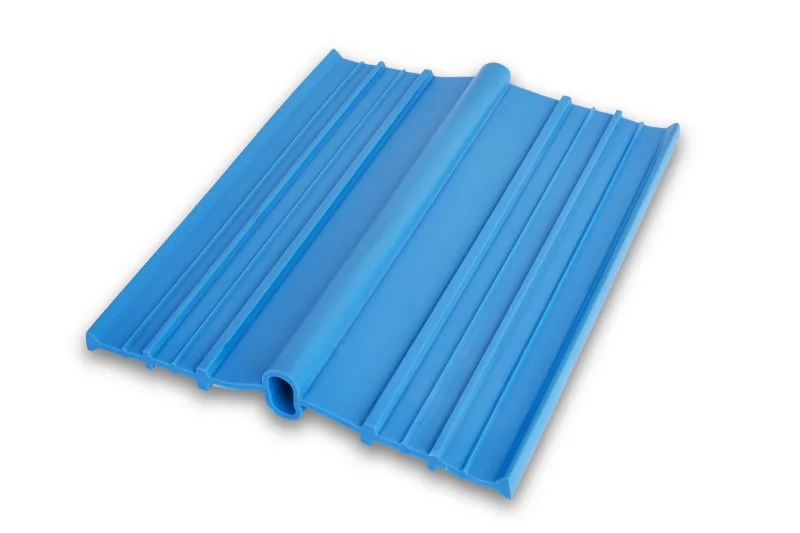
For an internal PVC expansion joint waterstop, the central bulb is positioned over the joint gap, while the ribbed wings are embedded in the concrete on both sides. When the joint opens, closes, or undergoes lateral displacement, the center bulb deforms to accommodate movement. The embedded wings help maintain the barrier within the concrete.
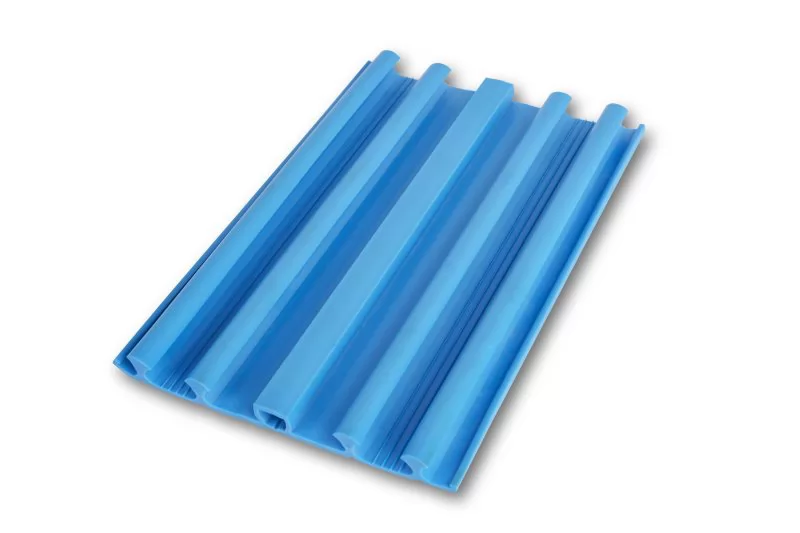
External expansion joint waterstops use a different arrangement. They are installed on the exterior face of the joint and bridge the gap from outside the concrete. Their performance depends on the profile, anchoring or bonding method, substrate condition, and compatibility with adjacent waterproofing layers.
Expansion Joints vs. Construction Joints
Not all concrete joints require the same waterstop design. A construction joint is generally formed when concrete placement is interrupted, whereas an expansion or isolation joint is intentionally designed to permit relative movement between adjoining elements.
| Comparison | Construction Joint | Expansion Joint |
|---|---|---|
| Primary purpose | Accommodates interruptions in concrete placement | Allows relative movement between concrete elements |
| Expected movement | Generally limited after the concrete has cured, depending on structural design | Movement is intentionally accommodated |
| Typical waterstop profile | Flat-ribbed or dumbbell profile, depending on the joint design | Movement-capable profile, often incorporating a center bulb |
| Key design concern | Bonding, embedment, and resistance to water migration | Movement capacity, profile deformation, and waterproof continuity |
Using a static-joint profile in a joint designed for significant movement can create excessive stress in the waterstop. The correct selection should therefore begin with the structural joint classification rather than simply choosing a familiar PVC strip.
For additional background on static-joint applications, see the PVC waterstop guide for construction joints.
2. How Joint Movement Affects Waterstop Performance
The defining requirement of an expansion joint waterstop is its ability to accommodate the movement expected at the joint without losing waterproof continuity. A profile that performs well under one movement condition may not be appropriate when the joint experiences movement in several directions.
Joint Opening and Closing
Joint opening occurs when the distance between adjoining concrete elements increases. Joint closing occurs when that distance decreases. These movements can result from temperature changes, shrinkage, seasonal conditions, and other structural effects.
When the joint opens, the waterstop must deform without becoming excessively stretched. When the joint closes, its profile must accommodate compression without folding or becoming trapped in a way that damages the material or interferes with the joint detail.
Lateral and Transverse Displacement
Some joints experience more than simple opening and closing. Differential settlement, structural deflection, or other loading conditions may cause adjoining concrete sections to shift relative to one another.
These movements can create lateral or transverse displacement across the joint. A center-bulb profile is commonly used in movement joints because its central geometry provides a deformable region that can accommodate several movement directions.
Why the Center Bulb Matters
The center bulb is not simply a visual feature. It provides a flexible zone over the joint gap, helping reduce direct tensile stress on the waterstop body as the joint moves.
The size and geometry of the bulb should be evaluated in relation to the anticipated movement range. A larger bulb may provide additional deformation capacity in some designs, but it does not automatically make a profile suitable for every project. Material properties, profile thickness, joint geometry, and installation conditions must also be considered.
For a technical reference, Sika's PVC Waterstop Design Guide describes center-bulb profiles for moving joints and explains how profile geometry relates to different movement directions.
3. Five Factors to Consider When Specifying an Expansion Joint Waterstop
Specifying an expansion joint waterstop requires more than choosing a product width or material. The following five factors provide a practical framework for evaluating whether a profile is appropriate for the project.
3.1 Expected Joint Movement
Start with the movement data provided by the structural engineer. This should include the anticipated maximum joint opening, maximum closing, and any lateral or transverse displacement that the waterstop may experience.
Where relevant, the design team should also consider whether movements are reversible, cyclic, or likely to occur gradually over the structure's service life.
The selected waterstop profile should have documented suitability for the required movement conditions. Avoid assuming that a profile's flexibility or elongation at break alone establishes its allowable joint movement. Material elongation is not the same as the verified movement capacity of an installed waterstop system.
3.2 Joint Width and Concrete Thickness
Joint width influences the space available for the waterstop's movement-accommodating section. Concrete thickness also affects the amount of embedment available and the way the profile can be positioned within the structure.
For internal waterstops, the design team should check whether the profile can be embedded adequately on both sides of the joint without interfering with reinforcement or concrete placement. The waterstop must remain properly supported and must not obstruct the intended joint gap.
For external waterstops, the available concrete face, anchoring area, surface condition, and waterproofing termination details should be checked before the profile is selected.
3.3 Hydrostatic Water Pressure
Water pressure is an important consideration in basements, tunnels, reservoirs, treatment plants, underground parking structures, and other below-grade or water-retaining applications.
The design review should identify the maximum expected water head and whether pressure may act from one side or either side of the joint. The waterstop profile must be evaluated as part of the complete waterproofing assembly rather than as an isolated strip.
Hydrostatic performance can be affected by profile dimensions, embedment, concrete consolidation, joint movement, and the quality of splices. A waterstop that has adequate material strength may still leak if water can migrate around the profile or through poorly executed connections.
3.4 Waterstop Material Compatibility
PVC is widely used for concrete waterstops because it can be manufactured into flexible profiles and heat-welded to form continuous runs. However, the appropriate PVC compound depends on the service environment and project requirements.
Consider the following conditions before specifying the material:
- Temperature: Confirm that the material retains suitable flexibility under the expected operating and installation temperatures.
- Water exposure: Review whether the waterstop will be exposed to groundwater, treated water, seawater, or other liquids.
- Chemical exposure: Check compatibility with cleaning agents, wastewater constituents, or process chemicals where applicable.
- Mechanical demands: Evaluate tensile strength, elongation, hardness, and other relevant properties using the manufacturer's technical data.
- Regulatory requirements: Confirm any project-specific requirements for potable water contact, environmental declarations, or material certification.
For example, Sika's design guide identifies movement accommodation and liquid compatibility as important considerations in PVC waterstop selection. The actual suitability of a compound should nevertheless be confirmed using product-specific test data.
3.5 Installation Position and Accessibility
The installation position influences both the waterstop configuration and the construction sequence. An internal profile is embedded within the concrete, while an external profile is installed along the exterior face of the joint.
For internal installations, the project team should check reinforcement congestion, fixing arrangements, formwork access, and the ability to consolidate concrete around the profile.
For external installations, the team should consider access to the concrete face, substrate preparation, fixing methods, protection during subsequent work, and integration with membranes or sealants.
| Design factor | Information to confirm | Why it matters |
|---|---|---|
| Movement | Opening, closing, lateral and transverse displacement | Determines whether the profile can accommodate the joint movement |
| Joint geometry | Joint width, concrete thickness, reinforcement layout | Confirms profile fit and installation feasibility |
| Water pressure | Design water head and pressure direction | Helps establish waterproofing performance requirements |
| Material | Temperature, chemical exposure and service environment | Confirms material compatibility |
| Installation | Internal or external position, access and fixing method | Reduces installation and detailing risks |
4. Internal vs. External Expansion Joint Waterstops
Internal and external expansion joint waterstops serve the same broad purpose: maintaining waterproof continuity across a moving concrete joint. However, they differ in location, installation sequence, access, and integration with other waterproofing components.
Internal Expansion Joint Waterstops
Internal waterstops are positioned within the concrete section, typically with the central movement-accommodating part aligned over the joint. Their wings are embedded in the adjoining concrete elements to create a continuous barrier through the structure.
This configuration is commonly considered for water-retaining structures, underground structures, tunnels, basements, and other applications where the waterstop needs to be integrated into the concrete assembly.
Key considerations include:
- Accurate positioning along the joint centerline.
- Secure fixing to prevent displacement during concrete placement.
- Careful concrete consolidation around the embedded ribs.
- Protection of the center bulb from concrete intrusion or deformation.
- Reliable welding at straight joints, corners, tees, and intersections.
FuFuJing's SO Series Internal Expansion Joint Waterstop is one example of a center-bulb PVC profile intended for internal movement joints.
External Expansion Joint Waterstops
External waterstops are installed on the exterior face of the concrete joint. Rather than being embedded centrally within the concrete, the profile bridges the joint from the outside and forms part of the external waterproofing arrangement.
This configuration may be considered where the project requires an external barrier, where the joint face is accessible during construction, or where the waterstop must be coordinated with surface membranes and protective coatings.
Key considerations include:
- Concrete surface preparation and substrate condition.
- Profile alignment across the full joint length.
- Appropriate mechanical or adhesive fixing according to the product instructions.
- Protection against damage during backfilling or subsequent construction.
- Continuity at terminations, corners, and transitions.
FuFuJing's KC Series External Expansion Joint Waterstop is designed for exterior-face installation in concrete movement joints.
Internal vs. External: A Practical Comparison
| Comparison | Internal Waterstop | External Waterstop |
|---|---|---|
| Installation location | Embedded within the concrete | Installed on the exterior concrete face |
| Construction timing | Positioned before and during concrete placement | Installed when the relevant exterior surface is accessible |
| Main installation concern | Embedment, fixing, and concrete consolidation | Surface preparation, fixing, and protection |
| Inspection access | Limited after concrete placement | Potentially more accessible before covering or backfilling |
| System integration | Coordinates with reinforcement and concrete joint details | Coordinates with external membranes and sealants |
Neither configuration is universally better. The decision should be based on structural design, water pressure direction, construction sequence, access, and the overall waterproofing strategy.
5. How to Match Waterstop Profiles with Project Conditions
Once the joint movement and installation arrangement are understood, the next step is matching the profile geometry to the project requirements. Profile selection should consider the intended joint function, movement directions, available concrete space, and manufacturer documentation.
Center-Bulb Profiles for Movement Joints
Center-bulb profiles are commonly used for expansion joints because the central bulb provides a deformable section over the joint gap. The ribbed wings on either side help anchor the waterstop within the surrounding concrete.
When evaluating a center-bulb profile, review:
- Central bulb geometry and available deformation space.
- Overall profile width and thickness.
- Wing and rib configuration.
- Compatibility with the specified joint width.
- Documented material properties and movement-related performance.
External Profiles for Face-Mounted Waterproofing
External profiles are selected when the waterproofing design places the waterstop on the exterior face of the joint. The profile must provide sufficient coverage across the joint and be compatible with the intended anchoring and waterproofing details.
Matching Profile Geometry to Project Requirements
| Project condition | Profile consideration | Design verification |
|---|---|---|
| Joint opening and closing | Movement-capable center-bulb configuration | Confirm movement range against product data |
| Multidirectional movement | Profile designed for lateral and transverse deformation | Review the complete movement envelope |
| Internal installation | Embedded center-bulb profile with suitable anchoring wings | Check embedment, reinforcement clearance, and concrete placement |
| External installation | External profile with suitable coverage and fixing details | Check substrate, anchoring, and membrane transitions |
| Custom joint layout | Profile and fittings matched to the joint arrangement | Confirm corner, tee, and cross connections |
Why Project Drawings Matter
Catalog dimensions are useful for preliminary screening, but they do not replace project-specific verification. A profile that appears suitable based on nominal width may not provide the required deformation capacity or fit the available reinforcement arrangement.
Before confirming a model, compare the manufacturer's cross-sectional drawing with the structural joint detail. Where necessary, request a custom profile or technical review based on the actual drawings.
For a broader overview of available PVC waterstop configurations, visit the FuFuJing PVC Waterstop product range.
6. Common Specification Mistakes That Can Lead to Leakage
Waterstop problems are not always caused by material failure. Leakage can also result from an unsuitable profile, incorrect installation, poor concrete consolidation, or discontinuities at joints and intersections.
Choosing a Static-Joint Profile for a Moving Joint
A flat or dumbbell profile intended for a non-moving construction joint may not provide the deformation capacity required by an expansion joint. If the profile is forced to accommodate movement beyond its intended design, excessive stress may develop at the joint.
The waterstop should therefore be selected according to the actual joint function and anticipated displacement.
Ignoring the Full Movement Range
Considering only the nominal joint width can lead to an incomplete specification. The joint may open, close, or shift after installation. The selected profile must be reviewed against the full movement range rather than a single dimension.
Allowing the Waterstop to Move During Concrete Placement
An internal waterstop that shifts, twists, or folds during concrete placement may no longer sit in the intended position. This can reduce embedment on one side or restrict the center bulb's ability to deform.
Appropriate fixing, support, and inspection before and during concrete placement are essential.
Poor Concrete Consolidation Around the Profile
Voids and honeycombing around an embedded waterstop can create pathways for water migration. Concrete should be placed and consolidated carefully around the profile, following the project method statement and avoiding damage or displacement.
Inadequate Welding at Connections
Waterstop runs often include straight joints, corners, tees, and crosses. Poorly aligned or incompletely fused connections can interrupt the waterproofing barrier even when the main strip is correctly specified.
For PVC waterstops, connections should be made using an approved welding procedure and compatible equipment. Where complex fittings are required, factory-fabricated components can help reduce the difficulty of field fabrication.
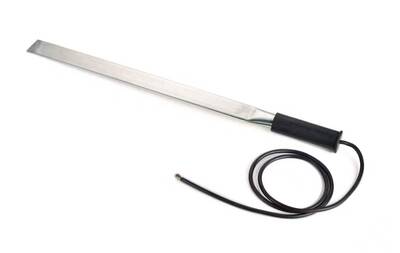
FuFuJing also supplies PVC Waterstop Heater Blades and waterstop jointing accessories for PVC strip connection work.
7. What to Include in an Expansion Joint Waterstop Specification
A clear technical specification helps engineers, contractors, and manufacturers evaluate the same project requirements. It also reduces the risk of selecting a profile based on incomplete information.
The following information should be included in the project documentation wherever applicable.
Project and Joint Information
- Project type and structural application.
- Concrete joint classification.
- Joint location and orientation.
- Nominal joint width and concrete thickness.
- Structural drawings and relevant joint details.
Movement and Environmental Requirements
- Maximum expected joint opening and closing.
- Lateral and transverse displacement requirements.
- Expected movement frequency or cyclic conditions, where relevant.
- Design water pressure or hydrostatic head.
- Operating temperature range.
- Water and chemical exposure conditions.
Product and Performance Requirements
- Waterstop material and compound requirements.
- Internal or external installation configuration.
- Required profile cross-section and nominal dimensions.
- Relevant mechanical property test methods and acceptance criteria.
- Required product technical data sheets and test reports.
- Applicable project-specific standards and certifications.
Installation and Connection Details
- Fixing and anchoring method.
- Concrete placement and consolidation requirements.
- Welding or joining procedure.
- Corner, tee, cross, and termination details.
- Inspection and acceptance criteria before concrete placement or covering.
Sample Specification Checklist
| Specification item | Project information |
|---|---|
| Joint type | Expansion / movement joint |
| Installation configuration | Internal / External |
| Waterstop material | Project-approved PVC compound or specified alternative |
| Nominal joint width | As indicated in structural drawings |
| Movement requirements | Opening, closing, lateral and transverse displacement |
| Water pressure | Specified design hydrostatic head |
| Profile dimensions | Width, thickness, bulb geometry and cross-section |
| Connections | Straight joints, corners, tees, crosses and terminations |
| Documentation | Technical data sheets, test reports and approved drawings |
Reference: ASTM D8530/D8530M-24 – Standard Guide for the Selection and Use of Waterstops.
8. Choosing a Waterstop Manufacturer for Custom Project Requirements
For projects with non-standard joint geometry, complex movement requirements, or demanding installation conditions, the manufacturer's ability to provide suitable profile configurations and technical documentation becomes an important part of the procurement process.
Rather than comparing products only by nominal width or price, project teams should evaluate the manufacturer's ability to understand the structural details and supply a profile that fits the intended waterproofing arrangement.
Review Profile and Customization Capabilities
A capable manufacturer should be able to provide clear cross-sectional drawings, standard profile options, and relevant technical information. For projects with unusual joint details, custom profile development may also be required.
FuFuJing provides internal and external PVC waterstop configurations, including movement-joint profiles such as the SO and KC series. The available product range can be reviewed through its PVC waterstop product catalog.
Check Technical Documentation
Before approving a product, request the relevant technical data sheet and confirm that the stated material properties and dimensions correspond to the proposed profile.
For a project-specific review, useful documents may include:
- Profile cross-sectional drawings.
- Nominal dimensions and dimensional tolerances.
- Material property test reports.
- Installation and welding recommendations.
- Available connection and fitting details.
Evaluate Jointing and Installation Support
Even a suitable waterstop profile can underperform if its connections are not fabricated correctly. Confirm that the manufacturer can provide suitable jointing equipment, connection guidance, and information about compatible fittings.
FuFuJing offers PVC waterstop jointing tools and accessories to support the connection of PVC waterstop strips. These products can be reviewed through the PVC waterstop product section.
Provide Drawings for a More Accurate Recommendation
When requesting a quotation or technical recommendation, provide the structural joint drawing, expected movement range, water pressure, installation location, and project environment. This allows the manufacturer to evaluate the profile requirements more accurately instead of recommending a product based on nominal width alone.
For custom requirements, visit FuFuJing to review the available PVC waterstop solutions and discuss project-specific profile requirements.
9. Conclusion
Specifying an expansion joint waterstop requires a clear understanding of how the concrete joint will move, how much water pressure the system must resist, and how the waterstop will be installed within the overall waterproofing assembly.
The most important considerations are the expected movement range, joint geometry, hydrostatic pressure, material compatibility, and installation position. Internal center-bulb profiles and external profiles offer different installation arrangements, so the appropriate solution should be selected according to the structural design and project conditions.
Equally important are the details that connect the waterstop into a continuous barrier. Proper fixing, concrete consolidation, welding, and treatment of corners and intersections all contribute to long-term waterproofing performance.
By preparing a complete technical specification and working with a manufacturer that can provide suitable profiles, drawings, and product documentation, project teams can make more informed decisions for concrete movement-joint waterproofing.
For internal and external PVC expansion joint waterstop options, explore FuFuJing's waterproofing solutions and contact the team with your project drawings and technical requirements.


